
Explaining the Die Linke surge
Some rough notes on avoiding electoral collapse
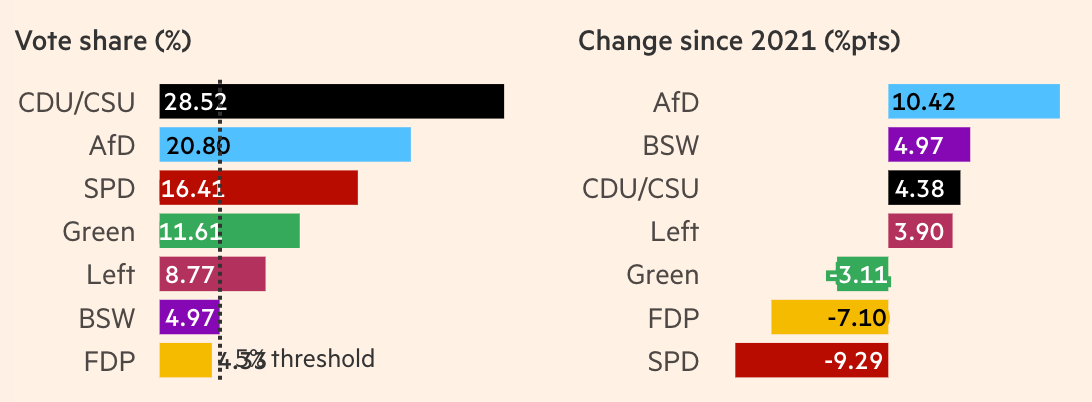
Final results from the 2024 election
With all the votes in from the 2024 German elections its clear Die Linke, the German left party, have made an unexpected surge - building from their historically low base of 4.9% in the last election and their 2.5% polling lows in 2024. While you wouldn’t describe Die Linke as a successful left project, it’s an interesting study in avoiding electoral collapse and a party coming back from near death.
I was in Germany for the run-up to the election and spent time with a bunch of Die Linke organisers. Here are my notes on the background to Die Linke’s woes, explanations for the surge, as well as some other interesting bits.
Sahra Wagenknecht nearly killed Die Linke
The left party in Germany has been in crisis for a number of years, falling from regularly polling 10% nationally and nearly 30% in the East of Germany to just 3% in 2024. The party became paralysed by disruptive in-fighting between Sahra Wagenknecht, their most visible spokesperson and partner of the party founder Lafontaine, and the various elected party leaderships. It was a classic problem of a high profile representative leveraging their individual media profile to overrule the party’s elected leadership, making a mockery of internal process. This was a problem Die Linke had also suffered with Lafontaine beforehand.
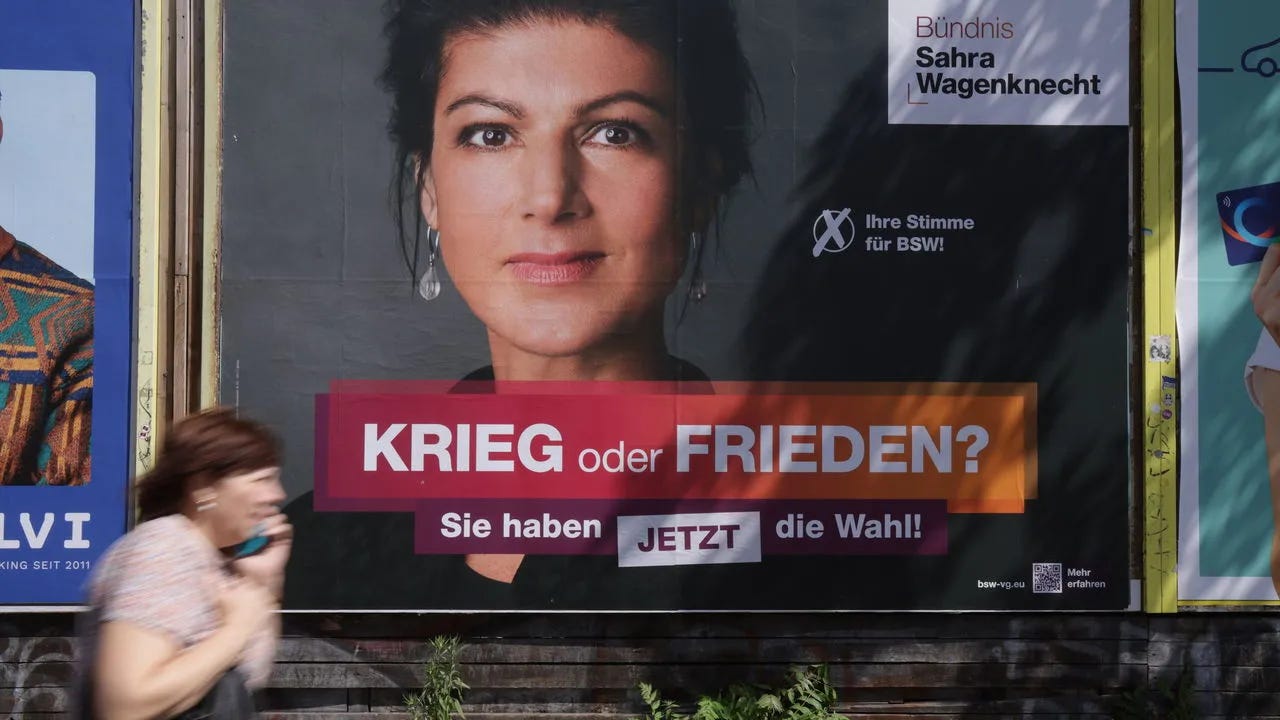
A campaign poster in the 2025 election
Disagreements centred on Wagenknecht’s programme for Die Linke: an economically left wing, socially conservative, anti-war agenda that she believed would head off the far-right AFD in East Germany (similarities can be drawn to Dan Carden’s Blue Labour turn in the UK). The standoff ended in October 2023 when Wagenknecht broke away to form her own party, the BSW, which had success in the East, joining governments with the CDU and SPD in Saxony and Thuringia, but has just missed the threshold to enter the Bundestag after achieving 4.97%.
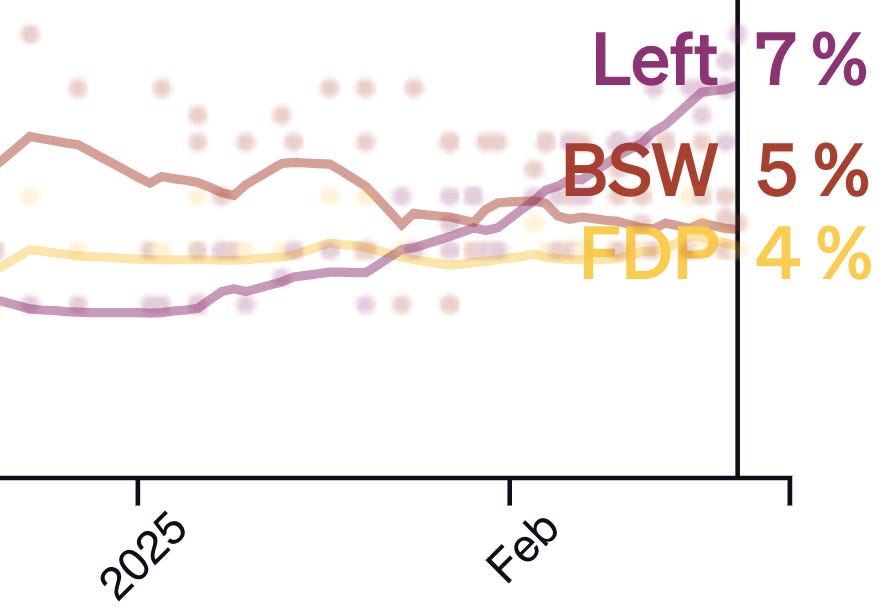
BSW and Die Linke reversal of fortunes over 2025
New leadership, new direction
Following Wagenknecht's departure and devastating results in the 2024 European and local elections, Die Linke elected a fresh leadership: Jacobin editor Ines Schwerdtner and lawyer Jan van Aken. Their immediate task was to reorient the party away from infighting and towards combatting the nearly existential threat of falling below Germany's 5% parliamentary threshold.
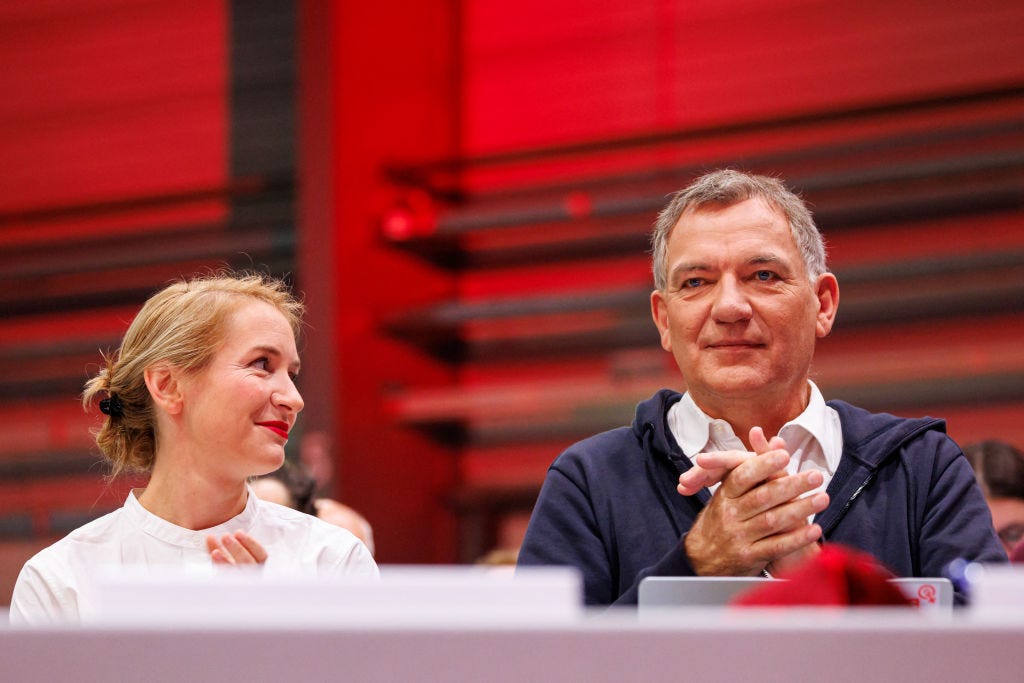
Ines and Jan from the October 2024 conference
The 5% threshold in the German Parliamentary system is important: exceed it and you are awarded with seats in proportion to your vote. Fall below while getting fewer than three direct mandates, and you’re out of Parliament completely. While executive power isn’t possible for Die Linke or the BSW, being in the Bundestag brings resources and profile that are important for long-term party building.
The Die Linke surge: Organising, unity and the firewall
Talking to insiders there were a few different reasons for Die Linke’s surge. Nobody would pin it to one thing along, arguing that it was a mix of door knocking, unity, new membership, a concrete platform, fear of the far right, Heidi Reichinnek’s TikTok and Mission Silberlocke:
Door knocking and listening campaign. Everyone we spoke to emphasised the importance of their listening campaign that kicked off after their October Conference in 2024. Instead of following the usual party process of “writing a manifesto based on what we believe” they set out to talk to voters about their priorities, knocking on 30,000 doors in a few months and finding out what people cared about. The purpose was threefold: build a manifesto at the meeting point between voters desires and Die Linke’s politics, rebuild branches in areas that had been decimated by Wagenknecht’s departure and shift the party from an internal to external focus. This was new for the party, and it was a battle to avoid the usual process of determining the manifesto based solely on the desires of the membership.
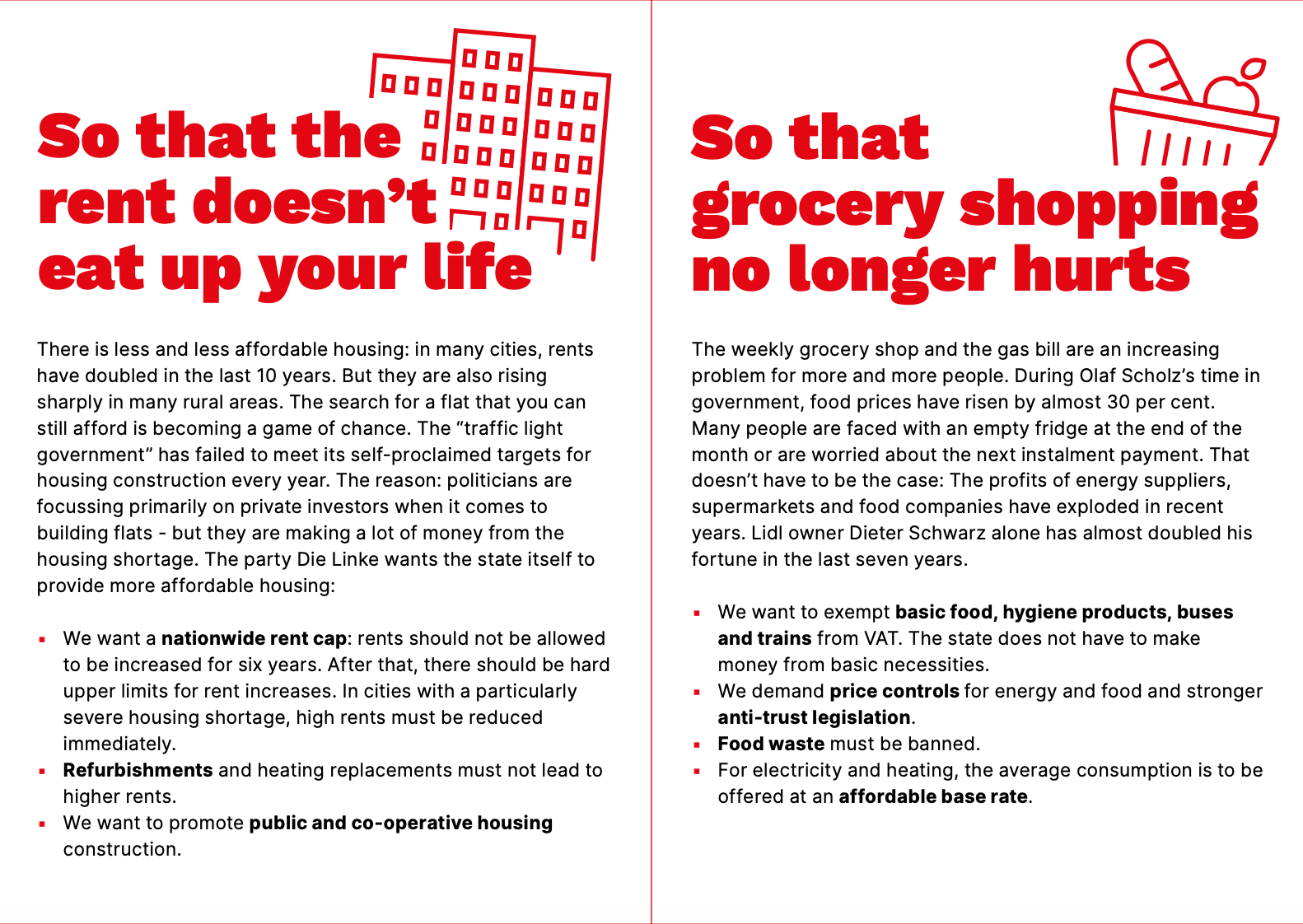
Concrete platform. As a result of the listening campaign, their platform focussed on concrete issues that mattered to votes: lower rents and lower prices. In the words of one organiser they “dropped talking about the climate catastrophe and open borders”. Climate only appears at the bottom of the platform and Die Linke were clear they opposed carbon taxes that hurt working class people. Migration doesn’t feature at all.
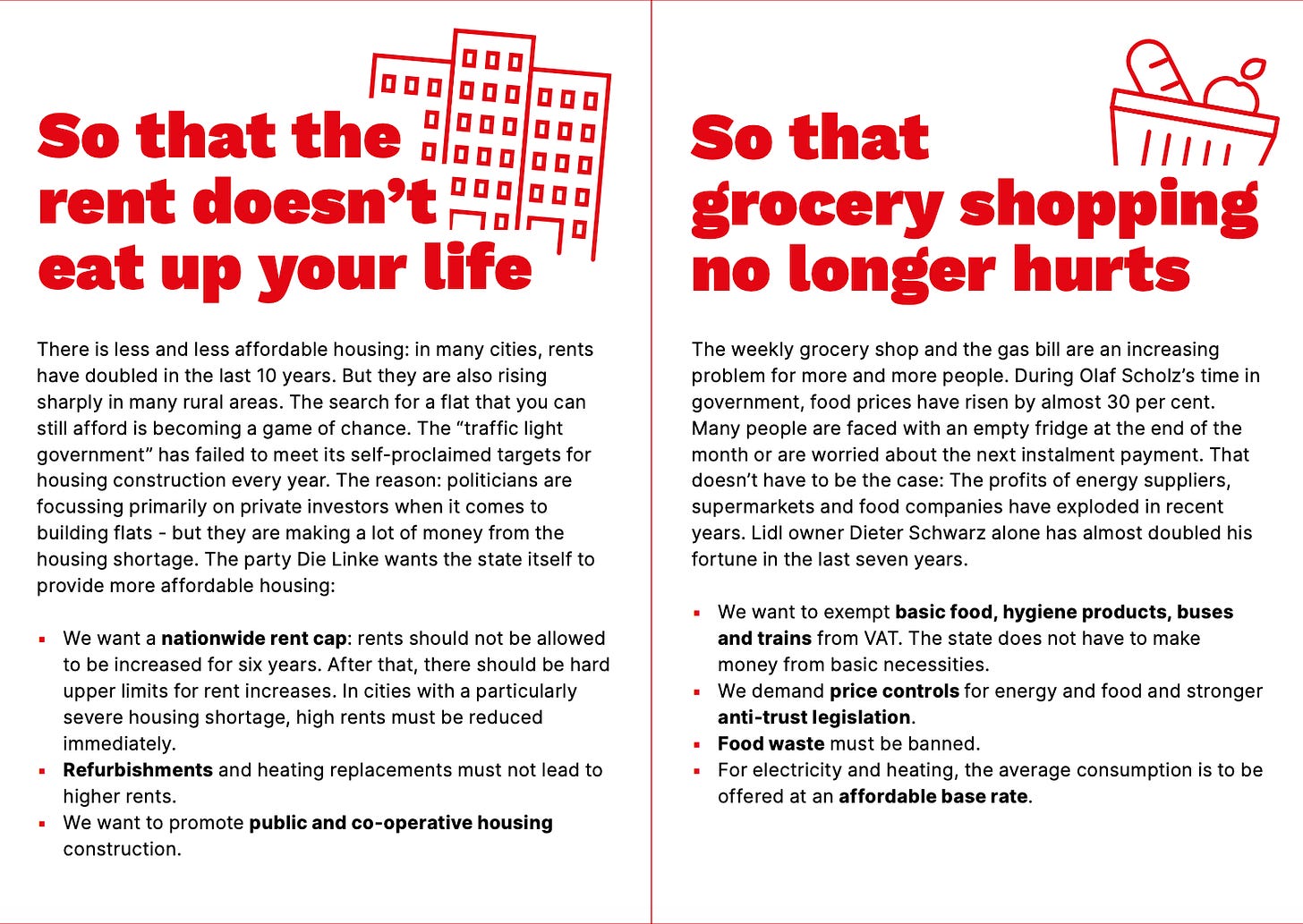
An extract from the English translation of their 2024 programme.
Unity through membership recomposition and dialogue. The party lost 8000 members in 2024 but gained 17,000. Half of their members, many of whom are younger, have joined in the last 1.5 years. This recomposition of the membership, through young people joining and Wagenknecht’s faction leaving, has created the conditions for a new party unity. More recently a Zionist faction left after the October conference in 2024, which helped the party come to an agreed position on Palestine in an intensely pro-Israel German political climate. The new leadership also ran a member calling operation, getting staff on the phone to members, trying to engage them in the listening campaign but also to bring the staff closer to the membership. The leadership are clear with the membership: if you have a problem, talk to us. Don’t air your dirty laundry in public.
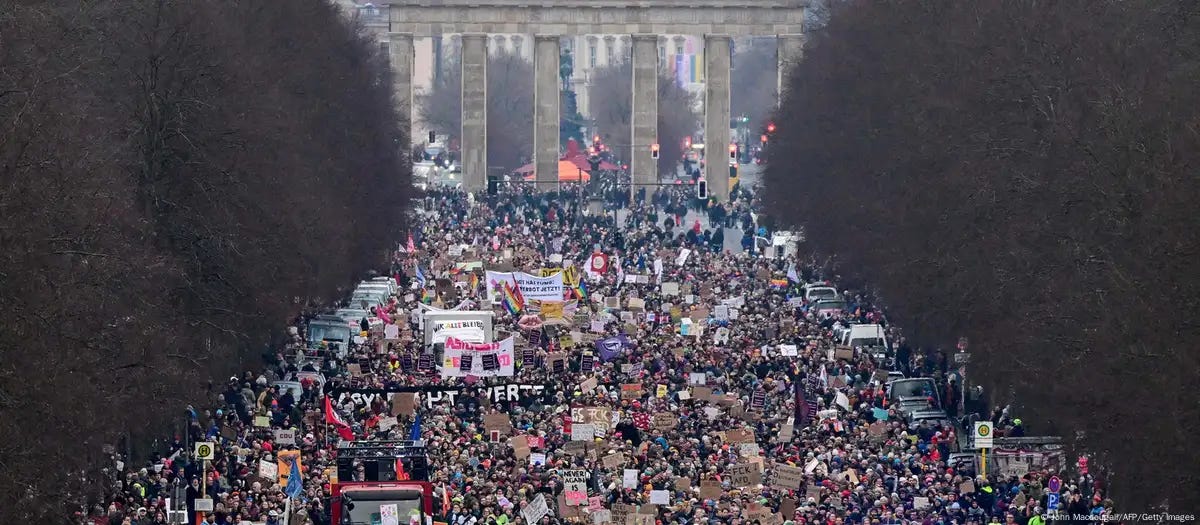
Fear of the far right and Heidi Reichinnek’s TikTok. A pivotal issue in the election was the migration bill put forward by Fredrich Merz, the CDU leader, that could only pass with AFD support. This was in breach of the German political ‘firewall’ where no party is supposed to work with the far right. There were huge protests across the country in response to the bill, with as many as 160,000 turning out in Berlin, and protestors occupying CDU offices in Charlottenberg, Berlin.
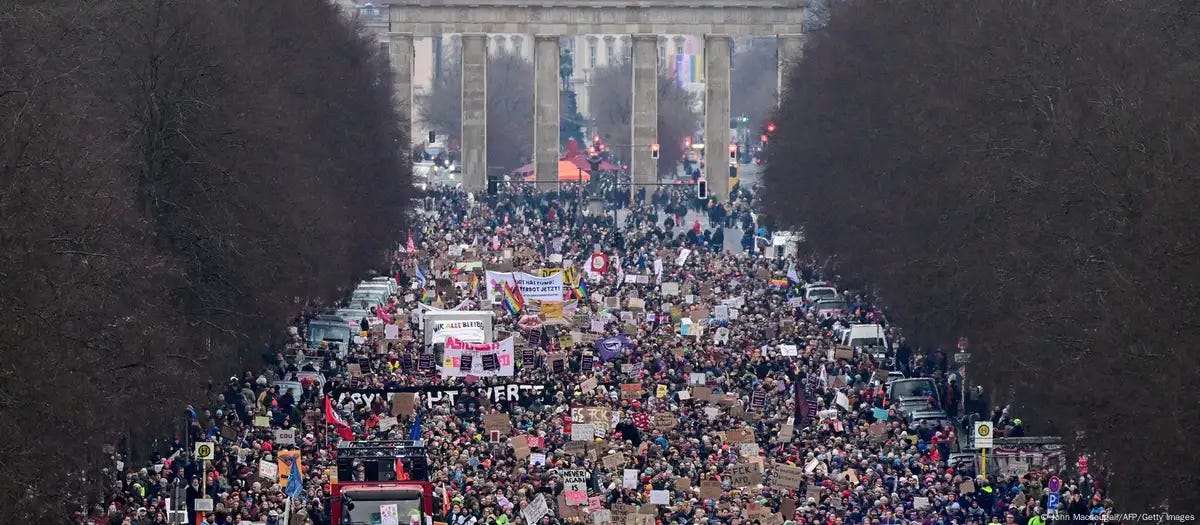
Huge protests in Berlin
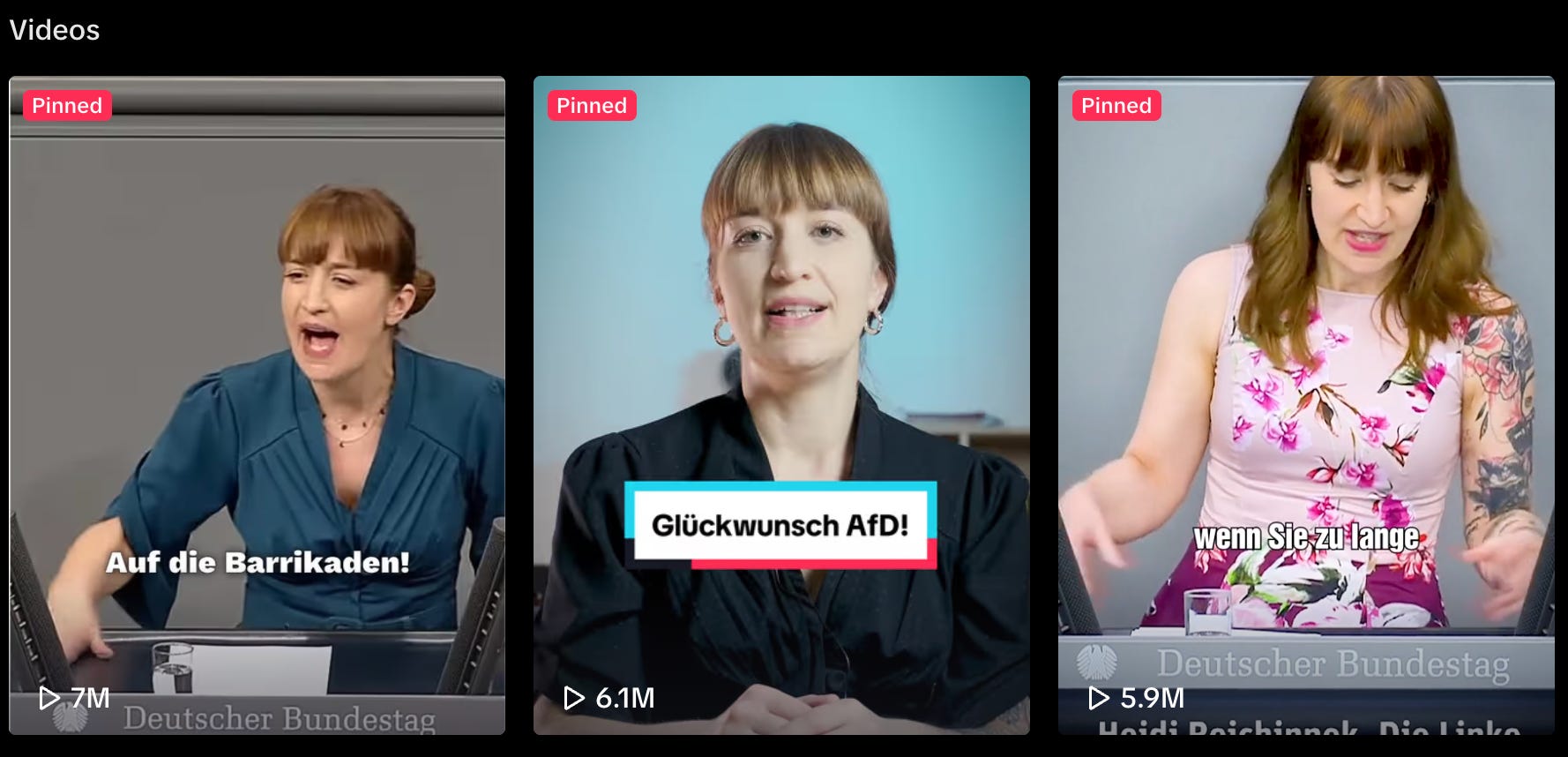
Die Linke were present on these marches but what really helped them capture the surge was their leader in the Bundestag Heidi Reichinnek, who made an impromptu speech calling people “to the barricades" and gained more than 20 million views across all platforms.
Reichinnek had been the most popular German politician on TikTok for many years, but it was only when her popularity combined with a crisis moment that it started to push up Die Linke’s polling numbers.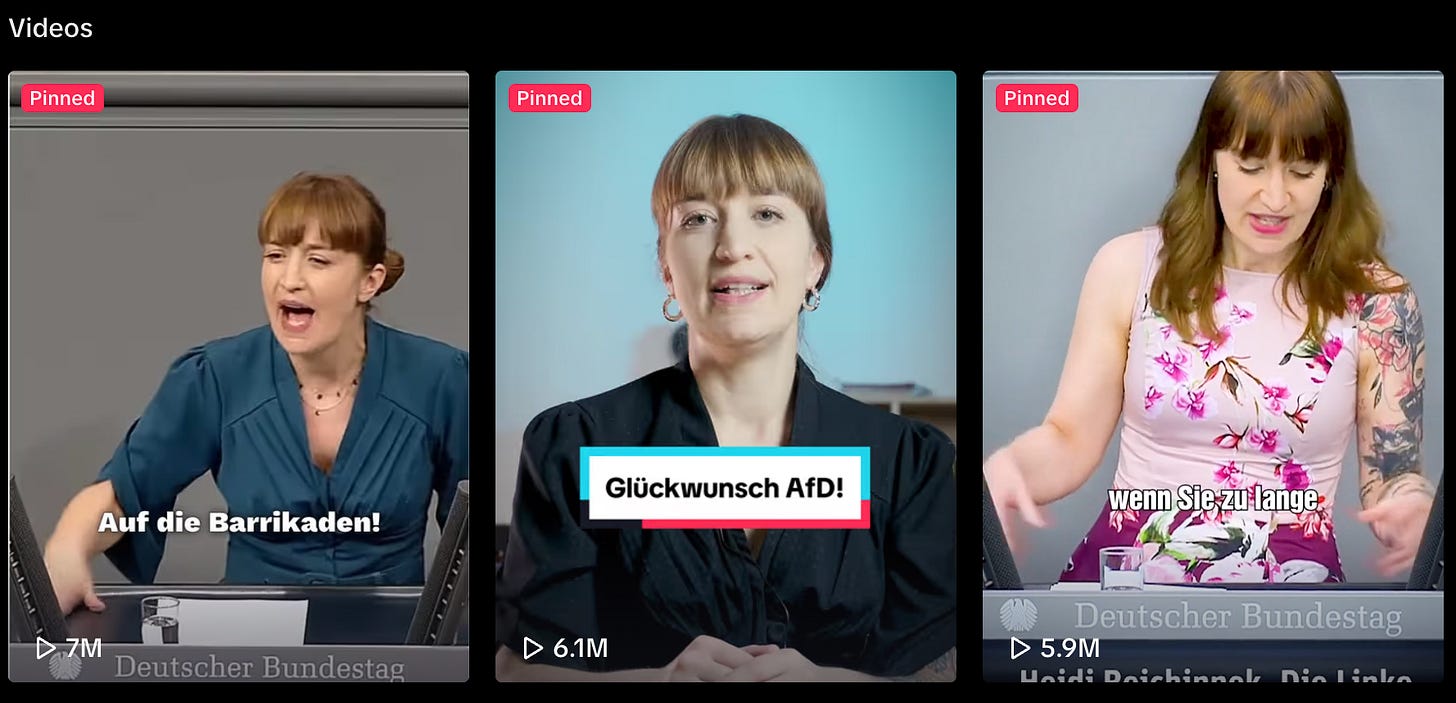
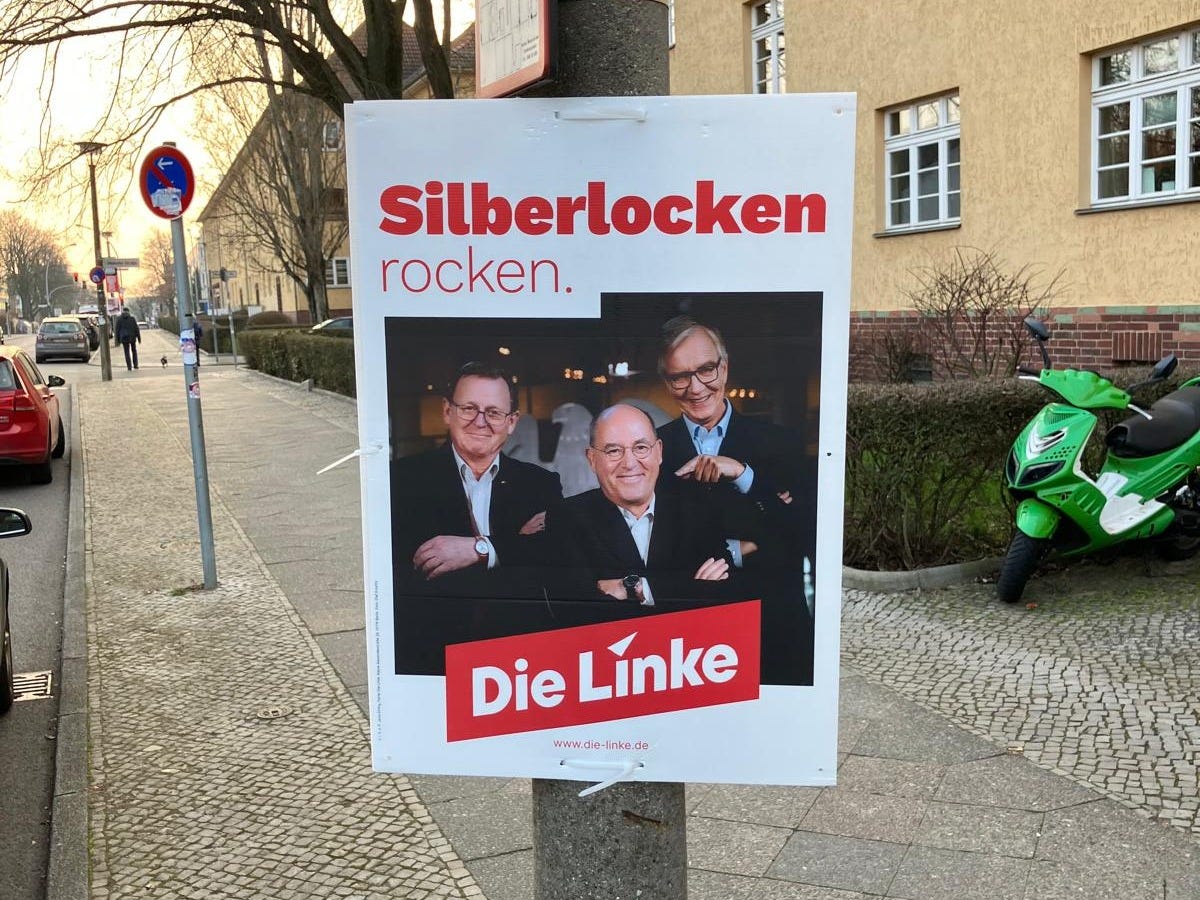
Mission Silberlocke. Continuing the trend of running old white guys who have no business whipping up excitement and cutting through, Die Linke’s tongue in cheek “Operation Silverlock” saw three party grandees running for three of their direct mandates.
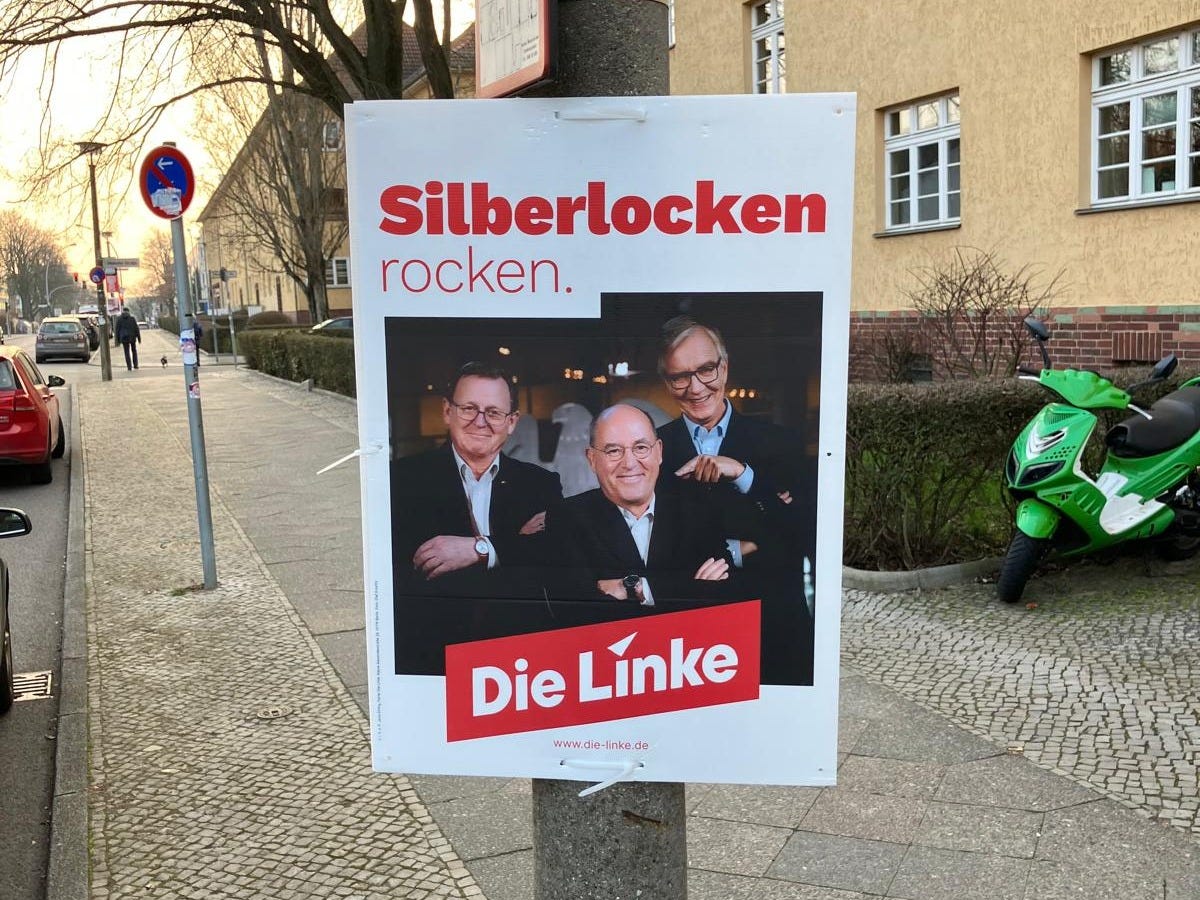
Campaign poster in Lichtenberg, East Berlin
According to officials this caught the public’s attention, and they’d certainly made an impression on the older, SPD voting couple we we were staying with. Corbyn, Sanders, Melenchon - I’m waiting for someone to write a psychoanalytic take on young people’s desire to campaign for older, father figures.
One final note that isn’t strictly relevant to Die Linke’s surge, but I found really interesting from a British perspective - how best to understand the East vs West split in Germany.
I’d always viewed the split through a rough deindustrialisation lens, similar to the British North-South divide. And while East Germany has suffered brutal deindustrialisation that has destroyed communities, the left’s traditional base and driven young people to the more prosperous West - very similar to how the loss of mining and heavy industry in the North of England pushed young people to the cities and London - this is only part of the story.
After the fall of the wall, Western powers were determined to maintain control over East German society and prevent any communist resurgence. This meant that for many years all top jobs were filled by West Germans, East Germany was chronically underfunded and East Germans treated as second class citizens. Just as an example, a degree from an East German university under the GDR was worthless after the fall. If you were unlucky enough to study there, you had to retrain or get a blue collar job.
More than just a process of deindustrialisation, Die Linke comrades described it as a process of internal colonisation - closer to Britain’s relationship with Ireland than the dynamic between Britain’s North and South. When we’re thinking about the rise of the AFD and Die Linke’s difficulties in the east, we should keep this context in mind.